 Insights, Stories & Impact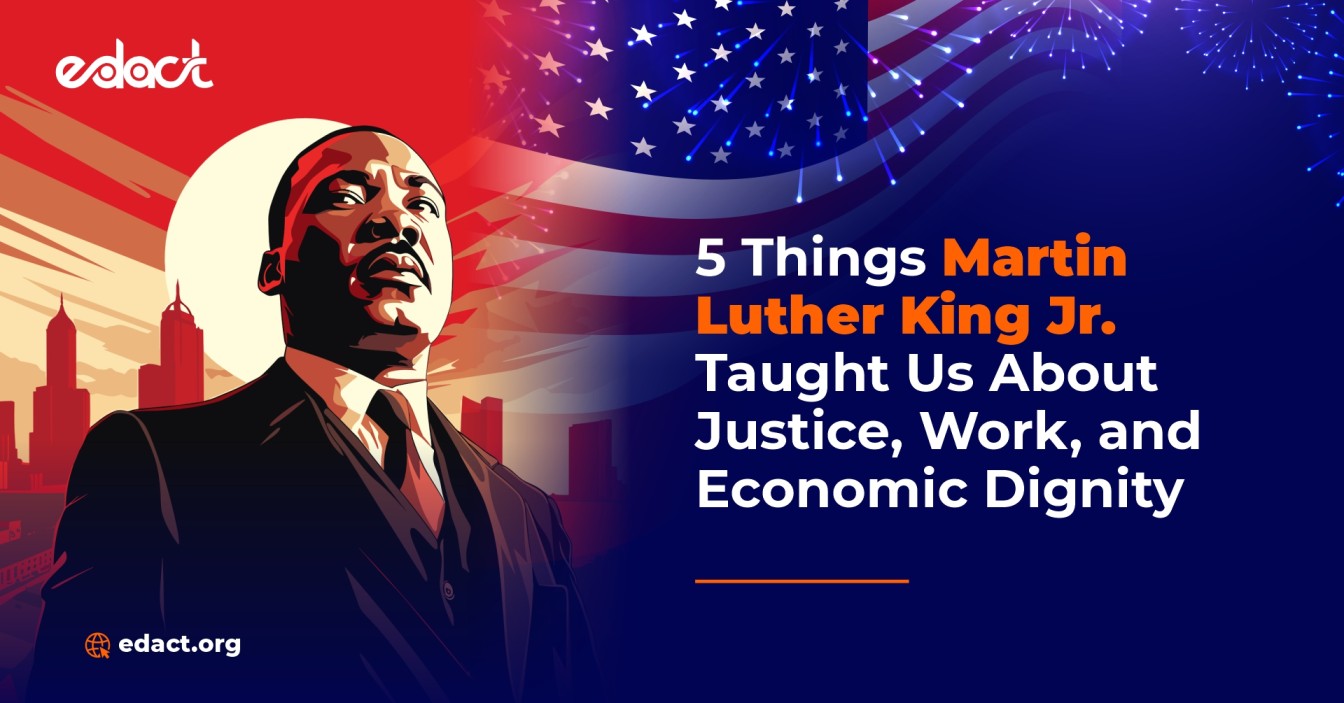
If Dr.King was looking at our world in 2026, at the harsh rhetoric that raises fear and the widening economic gaps, what would he say to those of us building businesses, supporting families, and fighting quietly for a fair chance?
In August 1963, Martin Luther King Jr. stood at the Lincoln Memorial and called out not just racism, but economic injustice.
More than 60 years later, the setting may have shifted, but many of the pressures feel familiar. Our communities still live with the impact of policies, rhetoric, and decisions that make immigrants and people of color feel unwelcome, unsafe, or left behind. From national political conversations to local realities, many of the people EDACT serves are again asking:
Where is justice in my everyday life?
For an organization like EDACT, whose mission is to help BIPOC and immigrant-owned businesses access equity and stability, Dr. King’s words are not historical quotes. They are current instructions.
With that, here are five things he taught us about justice, work, and economic dignity and why they matter now more than ever.
1. Justice Is Economic, Not Just Legal
“Injustice anywhere is a threat to justice everywhere.”
Dr. King wasn’t only talking about courts or voting rights; he was talking about pay, opportunity, and whose work is valued. He understood that you cannot speak honestly about justice while ignoring who gets hired, who gets funded, who gets credit, and who gets left out.
In 2026, when many minority-owned businesses still struggle to access capital, contracts, and information, justice looks like practical access to funding, training, and fair treatment in the marketplace. This is exactly where EDACT stands: helping turn “justice” from a slogan into something you can see in your books, your contracts, and your daily work.
2. Work Must Come With Dignity
“Everybody can be great because anybody can serve.”
Dr. King saw deep value in everyday work, whether it was a sanitation worker or a teacher.
But he was clear on one thing: for work to be truly dignified, it must be respected and fairly rewarded.
Today, many immigrant and BIPOC entrepreneurs work incredibly hard yet remain one crisis away from losing everything. Dignity at work means not having to choose between paying staff and paying yourself, between rent and reinvestment. EDACT’s financial literacy programs, business development support, and technical assistance exist so that hard work can lead to stability.
3. Systems, Not Individuals, Create Inequality
Dr. King consistently challenged the idea that people were poor because they were lazy. He pointed to structures: discriminatory laws, blocked access, segregated schools, and closed financial doors.
In 2026, when national leaders and public figures use language that targets immigrants and communities of color, the impact is not just emotional. It shows up in policy, in enforcement, in who feels safe to apply for a loan or register a business.
EDACT’s role is to help entrepreneurs navigate these systems: to translate policy into plain language, to point to real resources, and to make sure that people who were never meant to “fit” into the system can still find a path through it.
4. True Peace Requires Justice, Not Quiet
“True peace is not merely the absence of tension; it is the presence of justice.”
It can be tempting, especially in a tense political climate, to stay quiet and to avoid difficult topics. But Dr. King warned that quiet can be dangerous if it allows unfair systems to continue untouched.
For EDACT, this means we cannot talk about business without talking about who has been left out of business. We cannot discuss “access to capital” without acknowledging why that access was denied for generations. Our work must be calm, clear, and constructive, but it cannot be empty of truth.
5. The Work Belongs to All of Us
Dr. King never framed justice as the job of a few leaders. He spoke to communities, churches, workers, parents, and students. Change, he believed, was a shared responsibility.
In that same spirit, EDACT doesn’t position itself as a saviour, but as a partner. We create tools, training, and spaces,but the power lies in the entrepreneurs, providers, and community members who show up, ask questions, and keep building even when the climate is harsh and the messages from above are discouraging.
Why MLK Day Still Matters for EDACT and Our Community
Martin Luther King Jr. Day is not just a day off. It is a reminder that economic dignity is part of civil rights, and that the struggles of the 1960s are not as far away as we’d like to believe.
In a time when political language often undermines the safety, belonging, and legitimacy of the very communities EDACT serves, Dr. King’s message still rings true.
Whether you are part of a minority group or you’re simply a small business owner, your voice is part of this story of justice and dignity.
EDACT is here to help you navigate systems, access resources, and build something stable in a world that often feels unstable.
Stay connected with us this year for practical tools and resources designed to help your business thrive with dignity.